How StateJar extracts facts with 96% precision
On the 345-message release-gate set, StateJar's extraction measured 96.4% precision and 91.4% recall. Here is how deterministic checks decide what becomes memory, and why it declines rather than guesses.
A memory layer is only as good as the facts it stores. One wrong fact, stored with confidence, does more damage than a fact left out: the agent repeats it, builds on it, and the user stops trusting it. StateJar is built to decline rather than guess. On the release-gate set of 345 messages, StateJar's extraction measured 96.4% precision (95% interval 94.2% to 97.8%) and 91.4% recall (88.5% to 93.7%) on the code released on 3 November 2026. This post explains how the checks behind that number work.
What do precision and recall mean here?
- Precision is the share of stored facts that are right. 96.4% means that of every fact StateJar stored on this set, about 96 in 100 were correct.
- Recall is the share of labelled facts that were stored. 91.4% means that of every fact a person marked as worth remembering, about 91 in 100 were stored.
Source: StateJar release-gate set, 345 messages, 3 Nov 2026.
StateJar is tuned to keep precision high. When it is unsure, it leaves a fact out or holds it aside, because a missing fact can be said again and a wrong one is quietly repeated.
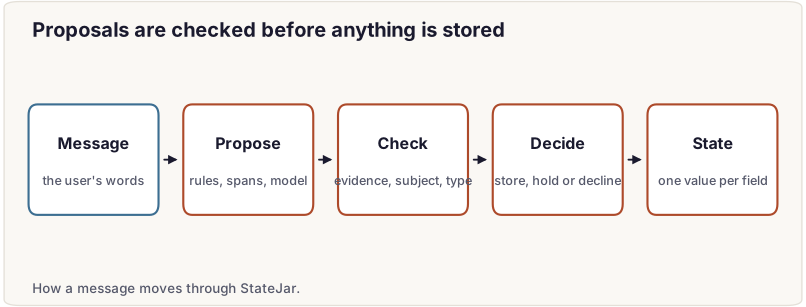
Step 1: several readers propose
Each message is normalised first: one form for text, digits and scripts, with the language noted. Long messages are split into chunks of about 1,500 characters with a sentence of overlap, so nothing is lost at a boundary. Then three kinds of reader propose facts:
- Rules for the forms that can be read exactly, such as phone numbers, e-mail addresses and amounts with a currency.
- Span finders that point at the words in the message that look like a name, a place or an organisation.
- A language model that reads the chunk and proposes facts with the exact words it took each one from.
None of them writes to memory. They only propose.
Step 2: deterministic checks decide
Every proposal goes through checks that are code, not a model, so the same proposal always gets the same decision:
- Evidence verbatim. The words a fact was taken from must appear in the message exactly as quoted.
- The value is in the evidence. A city, an amount or a name must be found in those words, not inferred from somewhere else.
- The subject is the user. "My brother lives in Delhi" is about the brother, not the user, and is not stored as the user's city.
- Asserted, not asked or imagined. A question asserts nothing. "If I moved to Goa" is hypothetical. "I used to work at a bank" is the past. None of them becomes a current fact.
- The value fits its field. Each fact is mapped to one canonical field and checked for its type. A word that is not an amount is not stored as a budget, and a fragment is not stored as an e-mail address.
Step 3: store, hold or decline
A fact is stored when two independent readers agree on it, or when a verifier gives a confident yes. A fact with a single weak source is held: it is not put in memory and never sent to a model, and it is stored if the user says it again within a few messages. Everything else is declined, each with a reason you can read, such as "about someone else" or "a question".
What is stored lands in a state with one value per field. A new value for the same field writes a new version that points to the one before, so a correction never deletes the history. Why AI agents need an audit trail for memory explains what that history makes possible.
Why not just ask a bigger model?
A model alone can be very good at reading text and still store the occasional fact that is not there, or that belongs to someone else in the sentence. The checks make the last step deterministic: whatever reads the message, the same rules decide what becomes memory, and every refusal says why. That is also what makes StateJar's memory checkable afterwards: every stored fact passed the same gate.
For how this memory performs on a public benchmark, read Exact memory for AI agents.
Quick start
pip install statejar
statejar login
from statejar import StateJar
sj = StateJar(session_tag="user-42")
sj.ingest("I'm Meera from Pune and I prefer email.") # typed facts, no transcript
hit = sj.recall("How should I contact Meera?", audit=True)
print(hit["memory_context"]) # the system message for YOUR model, nothing elseThe step-by-step version, with JavaScript and MCP, is Add memory to your agent in 5 minutes. The reference is in the docs, and plans are on the pricing page.
Try free or Talk to us.
Frequently asked questions
How accurate is StateJar's fact extraction?
On the release-gate set of 345 messages, measured on the code released on 3 November 2026, StateJar's extraction had 96.4% precision (95% interval 94.2% to 97.8%) and 91.4% recall (88.5% to 93.7%).
What happens to a fact StateJar is not sure about?
It is held aside: not stored and never sent to a model. If the user says it again within a few messages it is stored; otherwise it is dropped. Facts that fail a check are declined with a reason.
Does StateJar store facts about other people as the user's?
No. A check on the subject keeps facts about someone else, such as a brother's city, out of the user's own fields.
Is a question ever stored as a fact?
No. A question asserts nothing, so a question about your budget is never stored as your budget.